Welcome to
Jeff Chan's Home Page
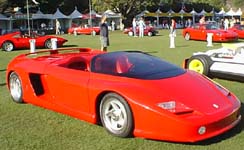


Some of the most popular pages on this site are in our Automotive section. Folks seem to enjoy our coverage of car shows, concours, races, etc. (Cars above are Pininfarina Mythos show car, Bugatti Veyron prototype, production McLaren F1.)
RAV4 EV Electric Car Owner Solar Panel Survey Results
As a member of the RAV4 EV mailing list, I did a survey of other owners of this wonderful 2000-era Toyota electric SUV to see how many were using solar panels to charge their cars and power their homes. The results in 2003 were that about half who responded used solar energy to charge their electric cars, resulting in actual zero emissions transportation.Promising Anti-Malware Approach
A great idea against malware are bootable USB flash drive-based malware scanners and cleaners.- FixMeStick is a Linux-based scanner and cleaner that uses Kaspersky, Sophos and GFI anti-malware engines. These are the among the best anti-malware programs available, but the major advantage is that FixMeStick runs them from a clean boot of Linux only and not under Windows. Since the possibly compromised Windows operating system never runs, this could be much more effective than Windows-based anti-malware. The system automatically updates itself using your Internet connection. The current license allows the scanning of 3 computers in any given month and lasts one year. Yearly renewals are half of the initial ~$50 price.
- Windows Defender Offline is a Windows PE system booted from USB, CD or DVD. The system is available as a free download from Microsoft. The installation process includes creating a bootable system and a fresh download of Microsoft's Windows Defender anti-malware program. The installer can also be used to update a USB-based installation.
If you use Windows, I urge you to use one or both of these. Many people have had their bank accounts stolen using malware on their Windows PCs. (BTW any computer is vulnerable to malware: Android phones, Apple phones, Mac computers, Linux machines, tablets, anything with a phone or Internet connection.)
IEEE Commemorates Xerox Alto's 50th Anniversary
IEEE Spectrum, the main IEEE periodical, has a nice March 2023 article about the history of the Xerox Alto, arguably the world's first personal computer. My brother and I saw Alto at Xerox PARC when it was on Hannover Street in Palo Alto, along with the newer Xerox Star. We saw these probably about the same time as Steve Jobs around 1979. Many of the Xerox people went to Apple to make the Mcintosh along the lines of the Star, and Microsoft made Windows along the lines of the desktop operating system of these.
The article is interesting because it mentioned a large team of people who shared a common vision for a future personal computer that was intuitive to use, like we have now. But it was all revolutionary at the time, not just hardware and software, but also concept. Much of the development of Dynabook and Alto was funded by ARPA research contracts both at Xerox and before. ARPA also funded the development of ARPANET, which became the Internet.
What prompted the article is the 50th anniversary of the Alto, and apparently the Computer History Museum in Palo Alto has restored an Alto to operational condition.
Recent Projects
- quakesignal.net
grassroots earthquake prediction using electromagnetic signals from the Earth.
This is based on research by Stanford Electrical Engineering professor
emeritus Antony C. Fraser-Smith.
- Seasteading is a movement to establish permanent settlements on the ocean.
A few of my favorite things
- EconTalk is a weekly podcast
of interviews about economics and freedom hosted by
George Mason University
economics professor Russ Roberts. It's a project of
Econlib, the Library
of Economics and Freedom.
It's available as MP3 downloads, iTunes, RSS feeds, etc.
- Richard Feynman's
Quantum Electrodynamics lectures
let us hear one of the 20th century's great physicists and
speakers describe this fascinating field in layman's terms.
- Tesla Motors
is bringing back the electric car in the form of an electric
Lotus Elise. Range is about 250 miles and acceleration is
about 4 seconds to 60 miles per hour.
Being mechanically a
Lotus and tuned by Lotus, handling and
feel are outstanding.
Along with a best-of-breed chassis, Tesla uses excellent
AC Propusion-derived
motor and controller and commodity Lithium
Ion batteries.
Tesla Motors is funded mainly by Elon Musk
along with Google and eBay folks.
- Private firm SpaceX is
single-handedly reviving the U.S. government manned space program
with highly-efficient new engines that scale from light to heavy lift.
(The heaviest lift Falcon 9 gets about a million pound-feet of thrust
from 9 Merlin engines.)
SpaceX is a commercial venture spearheaded by
physicist and Internet Entrepreneur Elon Musk.
Musk previously founded Paypal.
"The Merlin 1C next-generation, liquid-fueled rocket booster engine is among the highest performing gas generator cycle kerosene engines ever built, exceeding the Boeing Delta II main engine, the Lockheed Atlas II main engine, and on par with the Saturn V F-1 engine. It is the first new American booster engine in a decade and only the second American booster engine since the Space Shuttle Main Engine was developed thirty years ago."
- Scaled Composites,
Burt Rutan's innovative and daring aviation company,
pioneers air- and spacecraft like SpaceShipOne, with which
it won the X-Prize for the first private manned spacefights.
I was there for the first one.

Photo caption: Pilot Mike Melville stands atop SpaceShipOne with a sign that reads "SpaceShipOne Government Zero" after becoming the first private pilot to fly into space. Let's hope it's the start of a thriving private space travel industry.NEW: Photos of the first Space Ship One space launch from Gerry Liang

NEW: Photos of the first Space Ship One space launch from Gerry Liang - Synergy Aircraft
is an outstanding general aviation aircraft design with lots of
clever drag reduction that should be fast, efficient, stable,
simple, safe, reliable. The design is so good that it may be
the form of many future aircraft if it can overcome the newness barrier.
It looks like they are proposing suction boundary layer control for
parts of the wing and the tailing end of the fuselage, but even without
it, the twin box tail wing should be a huge improvement in drag over
other wing types due to the greatly reduced vortex generation
and increased laminar flow.
They claim 50 MPG fuel efficiency at over 200 knots, which would
be a huge leap forward in a small aircraft.
The quarter sale model appears to be unusually stable and benign
in flight,
which bodes well for the aerodynamic principles applied.
I really hope the full scale prototype gets completeed.
- Key components currenty undergoing laboratory development,
Reaction Engines' SABRE
hybrid airbreathing rocket engine is a brilliant
design that uses a closed-loop, Helium-medium Brayton cycle to cool the
engine, preheat the fuel, precool the air (oxidizer)
and drive the pumps and turbomachinery.
Due to the engine cooling, the engine itself can be built much lighter
than if it had to deal with the uncooled heat extremes of a non-cooled engine.
Heat energy comes from air heated at a conventional hypersonic shock inlet cone.
Cooling comes from the cryogenic Hydrogen fuel.
The engine can be used for hypersonic terrestrial travel or space launch.
A major advantage of using ambient air is that the oxidizer doesn't need
to be carried on board for travel in the atmosphere, making for a much lighter,
more efficient vehicle.
(For space launch, additional oxidizer is carried for use outside the atmosphere.
Breathing air
within the atmosphere very greatly reduces the amount of oxidizer
carried, overall vehicle mass, energy efficiency, size,
strength requirements, etc.)
The flight profile is gentler also, using wings to fly most of the
way to space. Note that this is a Hydrogen-Oxygen rocket engine
that happens to
use a turbine as air compressor. It is not a turbine engine.
Efficiency would far exceed ramjets, turbines, chemical rockets,
and nuclear-fission rockets.
"The Sabre engine is essentially a closed cycle rocket engine with an additional precooled turbo-compressor to provide a high pressure air supply to the combustion chamber. This allows operation from zero forward speed on the runway and up to Mach 5.5 in air breathing mode during ascent. As the air density falls with altitude the engine eventually switches to a pure rocket propelling Skylon to orbital velocity (around Mach 25)."
- On the other end of the aviation spectrum, the
Pipistrel
Virus SW
seems to be an unusually fast, fuel efficient,
very light aircraft.
Their aircraft names hopefully sound better in Slovenian than English.
- The motorgliders of
Stemme
are particularly elegant.
Their initial S10 model is fully streamlined like a pure competition
glider, but adds an unusal retractable tractor propeller design
and a mid-mounted Rotax 914 engine driven by a
forward Carbon fiber propshaft.
The twin prop blades fold and retract completely
into the front nosecone when
stowed which reduces drag significantly when gliding.
The S10 also has retractable front landing gear which reduces
drag further.
With both drag reduction schemes employed,
the S10 has an outstanding 50:1 glide ratio which means
it can glide 100 miles down to sea level
from a 10,000 foot cruising altitude.
Stemme also makes a pure glider S2 model, and the newer
S6 and S8 models have a permanently-deployed three-bladed props
for more of a bias towards touring motor gliding.
The highly-efficient S6-RT motorglider gets a steady-state
43 miles per gallon (18 km/liter) of automobile gasoline (mogas)
at a 55% power setting from its turbocharged Rotax 914S engine
while cruising at 173 miles per hour (151 knots) at 16,000 feet.
Truly elegant, efficient flying.
- While the Stemme S10 is now rare and expensive, the newer
Pipistrel
Taurus motorglider can do many of the same things for about
one tenth the price. With a 41:1 glide ratio,
the Taurus' aerodynamics may not be quite as refined as the Stemme.
There is also an electric version of Taurus.
- eBay's auctions
are a good fit to the transformative power of the Internet,
enabling commerce
on a personal-to-worldwide scale never seen before.
I met eBay founder Pierre Omidyar when he came to check on
their very first two Internet servers,
installed at our Best Internet
colocation facility in Mountain View, California.
- Google has
a strong "not invented here" sensibility, but gets
most of the stuff that it re-invents largely correct.
Their ethics of doing the right thing most often end up being
correctly implemented.
It also does innovate.
For example, their search engine is unique and obviously very good,
and their ad driven revenue model is astute.
Google's mail service gmail
is lean and excellent.
- Like many people, I use
Yahoo!'s news site.
Other services on their portal are very good, if sometimes
not as good as Google's.
Yahoo's communities and mindshare are first-rate,
even if Yahoo! hasn't found the commercial success of Google.
- FreeBSD is an
excellent, stable, fast, free, open-source operating system.
I find it much more consistent, stable and simple-to-use
than Linux and strongly prefer it for all my servers.
We used FreeBSD extensively for servers at Best Internet,
as did Yahoo and Hotmail.
FreeBSD has the excellent kernel-supported
pf firewall from OpenBSD.
Linux may be a more appropriate desktop operating system than FreeBSD,
but I use FreeBSD for desktops too.
Apple's OS X is based on Mach and FreeBSD.
BSD, widely used in the research and academic communties,
is also the basis for Sun's Solaris.
The open-source successor to BSD "Berkeley Unix", FreeBSD is ported
to Intel, AMD, SPARC, Alpha, ARM, ia64, pc98, etc.
Here are my notes on how to
put a FreeBSD installation ISO
onto a USB Flash Drive.
- DIY tabletop CNC can be done in many ways. A very popular
combination is:
- The Chinese SIEG X2 mill which is imported by many different companies including TheLittleMachineShop.com, Harbor Freight, Grizzly, and others in slightly different versions
- The CNC Fusion Mini-Mill CNC kit #2 - with X-Y-Z BALLSCREWS CNC conversion hardware kit (ballscrews, motor brackets, bearings, drive nuts, direct drive couplers, fasteners).
- The Probotix 3-Axis Monster Mill Stepper Motor Driver Kit CNC conversion electrical component kit (motors, drivers, power supply, computer interface). The USB breakout board may be more future-proof than the parallel port version.
- Mostly open source software
- Old computer
See for example Nick Raymond's review on Makezine.Bob Warfield's CNC Cookbook site is a great collection of ideas for DIY CNC. He, and other people, make good arguments that the G0704 mill is a good size. It's neither too small nor too large for things most hobbyists want to make at home. The X2 is borderline too small for some things, for example. G0704 is a bit larger than the big brother of the X2, the SEIG X3.
Hoss's G0704 CNC Conversion site is another great collection of ideas, including links, references and recipies for specific configurations. The G0704 with DMM AC servos could be very nice and a good step up from the somewhat small X2 mini mills. Get a G0704 with an R8 spindle.
Older stuff
If you use a Windows PC, here are some widely recommended and used anti-virus and anti-spyware programs:- ZoneAlarm
- AVG by Grisoft
- Spybot - Search & Destroy
- Ad-Aware
- SecCheck by myNetWatchman
- Trend Micro HouseCall - web-based virus and spyware scanner
- McAfee Avert Stinger - standalone antivirus
- F-Secure Easy Clean - lightweight, standalone malware and rootkit remover.
The interactive Online Inter-Network Mail Guide comes from the plaintext Inter-Network Mail Guide FAQ file, part of a general Email page.
World Wide Web Initiative (w3.org) -- includes HTML and HTTP specifications. My favorite HTML starting point is the Beginner's Guide to HTML. Here are International Characters in HTML. HTML Tables, Frames, Mozilla.org site, home of open source Firefox web browser and Thunderbird mail client.
Get your Web Colors here!
Web catalogs: Yahoo, and HotBot, and DEC's AltaVista all use different methods of cataloging the web. Originally a Stanford University grad student project, Yahoo! essentially hand categorizes web sites. The Yahoo! web catalog is a bit stale, but I find other content there very useful, such as their news and financial info. Another great feature of Yahoo is that its search results pages have links to other search engines. This sort of inclusivity builds on the strength of the other sites and simultaneously encourages its use as a portal. AltaVista and HotBot each claim to use unique technologies, and seem to produce different results form each other and Yahoo! HotBot is a Wired Magazine project.
I've found what may be a better search engine: Google! Originally a research project at Stanford, it yields very good results. Google is unusual in that it uses links to a given page to rank it's importance, the idea being that a page that's referred to often has a good chance of being authoritative or at least relevant. Google was recently looking for VC funding but instead has been funded privately by Andy Bechtolsheim, Sun Microsystem's hardware founder. Bechtolsheim, who continues to be at the forefront of technology and is now probably a billionaire, was at one point another struggling Stanford grad student.
One of the most useful ways to find stuff on Usenet is Deja News. Deja News has a very fast, searchable database of pretty much everything useful on Usenet. It's probably the quickest way to find things in the newsgroups, including simply reading them by group. Since it's web-based, you can get to it from anywhere with just a Web Browser, and nothing is downloaded to your machine (other than normal web page caching).
All of my domain registrations are now with GoDaddy.com. They're cheap and seem to work fine.
For great information about Internetworking see the
Cisco
Internetworking Technology Overview.
Another very good resource is
Connected:
An Internet Encyclopedia
which includes descriptions and documentation about much
of Internet networking.
For a closer look at the
Border Gateway Protocol (BGP),
which coordinates routing on the Internet, see Cisco's
Interdomain Routing document,
overview chapter (from ITO mentioned above), and
commands.
Avi Freeman of Netaxs has a good couple articles about using
BGP
for Multihoming
as an ISP.
Here is
a
sample BGP config with communities used to mark which ASNs the
routes come from.
Network Computing magazine has a good overview of various
routing
protocols including BGP, RIP, OSPF, etc.
Here is a link to Sprint's BGP policy. UUNet shared their current BGP community settings privately.
Looking glasses, route servers and remote traceroutes are useful tools for digging into routing issues. www.traceroute.org has a good collection of these. The Oregon IX route server near the end of the list is very useful since it has many dozens of views of the full Internet routing table.
BroabandReport.com's DSL FAQ is a good collection of information about DSL lines, provisioning, wiring, usage.
Berkeley UNIX has nearly 30 years of expert development. As a truly open operating system it is widely used, very efficient, and highly reliable and secure. Best Internet used freeware FreeBSD, and that choice and advocacy influenced acquiring company Verio to continue the practice of hosting web customers on FreeBSD. Verio is now one of the world's largest FreeBSD web hosting companies after Yahoo and followed by Savvis. Both versions of Berkeley UNIX are popular as servers throughout the Internet.